
In critical power applications, the bypass mode in a UPS system is often misunderstood. Some users assume that when the load is on bypass, the UPS is still protecting the load in the same way as normal inverter operation. However, this is not always true.
Bypass is an important function inside a UPS system, but it should be understood as an alternative power path, not as the preferred long-term operating condition.
What is UPS Bypass Mode?
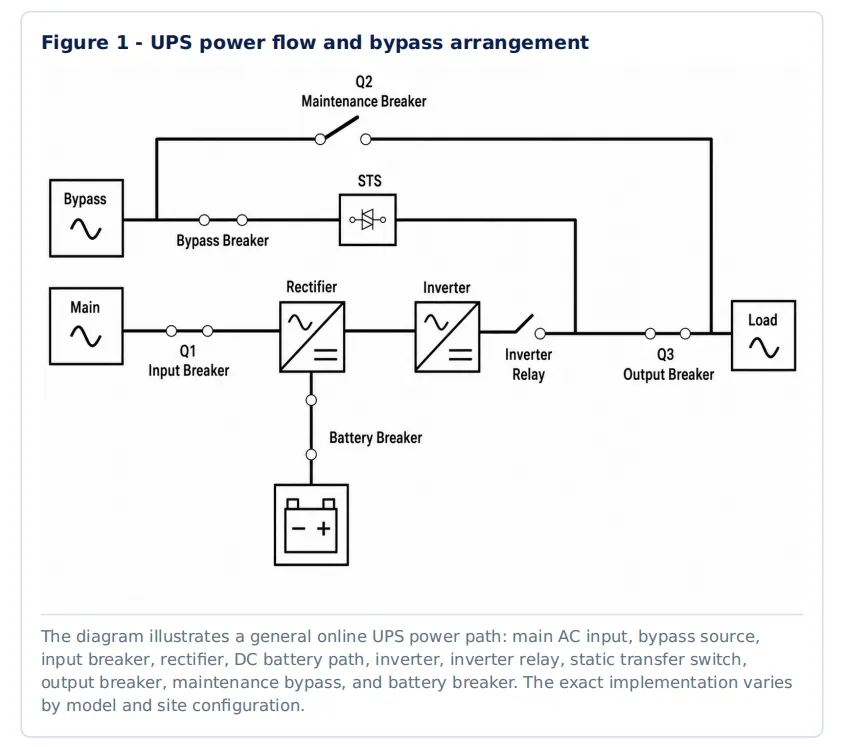
In normal operation, the UPS supplies the load through the rectifier, DC bus, inverter, and output stage. This path helps provide regulated and stable power to sensitive loads.
In bypass mode, the load is transferred to an alternative power path. Depending on the UPS design, this can happen through a static bypass path or a maintenance bypass path.
A static bypass is usually used for automatic transfer during overload, internal fault, or specific protection conditions.
A maintenance bypass is normally used to isolate the UPS for service while keeping the load energized.
The key point is simple:
Bypass keeps the load powered, but it may reduce the level of power protection normally provided by the inverter.
When is Bypass Mode Normal?
Bypass mode can be normal and acceptable in certain controlled situations.
It may be used during planned maintenance, commissioning, testing, or when the UPS needs to protect itself from an abnormal operating condition.
For example, if the UPS detects an overload or an internal inverter issue, it may transfer the load to bypass to avoid a complete shutdown. In this case, bypass helps maintain continuity, but the root cause still needs to be reviewed.
Bypass is acceptable when the reason is known, the source is stable, the load is within limits, and the system can safely return to inverter operation.
When Does Bypass Become a Risk?
Bypass becomes a risk when it happens without a clear reason, stays active for a long time, or keeps repeating.
If the load remains on bypass, it may be exposed directly to the bypass source. This means the load may no longer receive the same level of voltage regulation, isolation, and power conditioning provided during inverter operation.
Bypass can also be risky when it is caused by overload, unstable input, synchronization issues, high temperature, ventilation problems, or internal UPS faults.
Another important point is battery backup. If the load stays on bypass, battery backup may not protect the load unless the UPS can safely retransfer to inverter operation. If the bypass source fails and retransfer is unavailable or inhibited, the load may lose power.
What Should Be Checked?
When bypass appears, the first step should not be restarting the UPS immediately. The correct approach is to understand why the system transferred to bypass.
The user or technician should check the load level, alarm history, input voltage and frequency, bypass source condition, UPS temperature, ventilation, battery status, circuit breakers, and whether maintenance bypass was manually activated.
If bypass repeats or the UPS cannot return to normal inverter mode, the condition should be treated as a technical issue that requires proper investigation.
Technical Conclusion
Bypass is not a fault by itself. It is a necessary UPS function designed to maintain load continuity in specific situations.
However, bypass should not be treated as a normal permanent operating mode for sensitive loads.
The real question is not only whether the load is still powered, but whether it is still properly protected.
For critical loads such as servers, networks, cameras, control systems, and communication equipment, any repeated or unexplained bypass condition should be reviewed carefully.
PowerWadi Recommendation
Do not ignore bypass alarms.
Record the alarm message, check the load, verify the bypass source, review the environment, and contact a qualified technical team if the condition repeats or remains active.
PowerWadi can support critical power applications through UPS selection, system review, load analysis, bypass assessment, preventive maintenance, and troubleshooting.
PowerWadi — Reliable Power Solutions for Critical Applications
#PowerWadi #UPS #BypassMode #CriticalPower #PowerProtection #BackupPower #DataCenters #TechnicalWhitePaper #PowerQuality #ElectricalEngineering