
Choosing the right solar system is not only about inverter power. It starts with understanding the project objective, grid availability, backup requirements, critical loads, battery storage, and local utility conditions.
Download this PowerWadi Technical White Paper to compare On-Grid, Off-Grid, and Hybrid solar systems and identify the architecture that best fits your application.
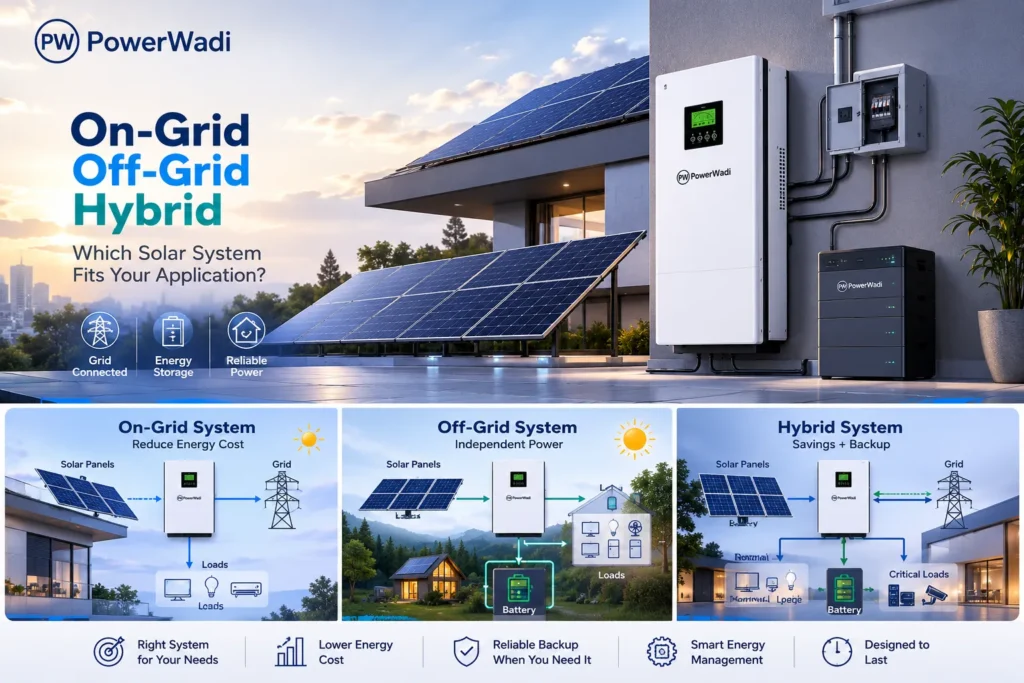
Choosing the Right Solar System Starts with the Application
On-Grid, Off-Grid, and Hybrid solar systems all use photovoltaic energy, but they are designed to solve different operational requirements.
The correct choice depends on whether the main objective is to reduce electricity costs, provide backup during grid outages, operate independently from the utility, or combine energy savings with controlled backup.
On-Grid Solar Systems
An On-Grid inverter operates in parallel with the utility grid. Solar energy is used to reduce imported electricity and support daytime loads.
This system is typically suitable for sites with a reliable grid and a strong daytime load profile.
A conventional On-Grid inverter normally disconnects during a utility outage as part of anti-islanding protection. Therefore, the presence of solar panels alone does not provide backup power.
Off-Grid Solar Systems
An Off-Grid system can operate independently from the utility grid.
Solar energy supplies the loads and charges the batteries, while stored battery energy supports the system when solar production is insufficient.
Off-Grid design requires accurate calculation of:
- Daily energy consumption
- Simultaneous load power
- Starting and surge current
- Required backup duration
- Battery usable capacity
- Available solar production
- Battery charging time
Increasing the inverter power alone does not increase backup duration.
Hybrid Solar Systems
A Hybrid inverter coordinates solar energy, the utility grid, and battery storage within one system.
Depending on the inverter model and configuration, the system can prioritize solar self-consumption, maintain a battery reserve, limit grid export, and energize selected critical loads during an outage.
Installing a battery does not automatically provide backup for the entire facility. The system must include a suitable backup output, correct transfer arrangement, sufficient inverter and battery capacity, and proper segregation of critical loads.
How to Select the Right Architecture
Before choosing the inverter or battery capacity, define:
- The primary objective: savings, backup, or both
- Grid availability and stability
- Critical loads that must remain operational
- Required backup duration
- Single-phase or three-phase configuration
- Export and metering requirements
- PV voltage, current, and MPPT limits
- Battery chemistry and BMS compatibility
- Installation and environmental conditions
The best system is not necessarily the most complex one. It is the system that achieves the required operational objective without unnecessary equipment or cost.
What You Will Learn in This White Paper
This technical guide includes:
- Operating principles of On-Grid, Off-Grid, and Hybrid systems
- Best applications for each system type
- Backup and battery requirements
- Side-by-side system comparison
- Common design misconceptions
- PV and battery compatibility risks
- Engineering selection checklist
- Key questions before project approval
PowerWadi Technical Support
Selecting the correct solar architecture requires verified load data and a clear understanding of the project objective.
Share your load profile, outage duration, available utility supply, and required backup loads with the PowerWadi Technical Team to identify the solution that best fits your application.