
A Technical Guide to Starting Power, Motor Loads, and Correct System Selection
Introduction
Operating motors, pumps, compressors, fans, and industrial equipment using a solar inverter requires more careful system design than operating standard electrical loads.
Selecting the inverter based only on the motor’s rated power in kilowatts is not enough. During startup, a motor may require significantly more current than it consumes during normal operation. If the inverter, batteries, cables, or solar array cannot provide this temporary demand, the motor may fail to start or the inverter may shut down.
This guide explains the main technical factors that should be considered when selecting a solar inverter system for motor applications.
Why Are Motor Loads Different?
Resistive loads, such as heaters and some lighting systems, normally draw a relatively stable current.
Motors behave differently because they require additional torque and current during startup. The starting current depends on several factors, including:
- Motor type and rated power
- Mechanical load connected to the motor
- Starting method
- Supply voltage
- Required acceleration time
- Cable length and cross-section
- Whether the motor starts loaded or unloaded
A motor that starts successfully without a mechanical load may fail when connected to a pressurized pump, loaded conveyor, or compressor.
What Is Motor Starting Power?
Starting power, also known as surge power, is the temporary additional power required by a motor during startup.
It is important to distinguish between two inverter ratings:
Continuous Power
Continuous power is the output power that the inverter can provide during normal and stable operation.
Surge or Overload Power
Surge power is the additional output that the inverter can provide for a limited period during motor startup or another temporary overload condition.
A high surge rating does not automatically mean that an inverter can start every motor. The surge duration must also be long enough for the motor to reach its normal operating speed.
An inverter that can provide double its rated power for only a fraction of a second may still be unsuitable for a motor that requires several seconds to accelerate.
Why Is the Motor Kilowatt Rating Not Enough?
The power shown on a motor nameplate usually represents the mechanical output available at the motor shaft. The electrical input required by the motor is affected by efficiency, power factor, voltage, and operating conditions.
Before selecting the inverter, review the following motor data:
- Rated power
- Rated voltage
- Rated current
- Number of phases
- Frequency
- Power factor
- Efficiency
- Rotational speed
- Connection method
- Duty cycle
The rated motor current is often more useful than the kilowatt value when assessing the inverter’s continuous output requirements.
Factors Affecting Motor Startup
Mechanical Load
The mechanical load has a major effect on startup requirements.
A fan or lightly loaded motor is normally easier to start than:
- A pump starting against high pressure
- A compressor with remaining pressure
- A fully loaded conveyor
- A mixer containing heavy material
- A machine starting under mechanical load
The greater the starting torque requirement, the greater the electrical demand on the inverter and energy source.
Acceleration Time
Some motors reach their normal speed quickly, while others require several seconds.
If the inverter’s overload duration is shorter than the motor’s acceleration time, the inverter may shut down before the motor reaches its operating speed.
Starting Frequency
Frequent motor starts place additional stress on:
- The inverter
- Batteries
- Cables
- Protection devices
- The motor itself
The expected number of starts per hour should be considered during system design.
Solar Inverter Requirements
The solar inverter converts energy from the solar panels, batteries, or utility supply into AC power for the connected loads.
For motor applications, review:
- Continuous output power
- Maximum output current
- Surge or overload capacity
- Overload duration
- Output voltage and frequency
- Output waveform
- Compatibility with inductive loads
- Protection response during startup
- Manufacturer recommendations for motor loads
The inverter should not be selected based only on a statement such as “double surge power.” The actual overload curve and allowable duration must be checked.
The Role of Batteries
In battery-based systems, the inverter draws the required startup energy from the batteries.
During motor startup, the inverter may demand a very high DC current. If the battery bank cannot supply this current, the system may experience:
- Battery-voltage drop
- Low-battery shutdown
- Battery Management System disconnection
- Inverter restart
- Motor startup failure
- Cable overheating
- Reduced battery life
The battery system should be evaluated according to:
- Nominal voltage
- Battery capacity
- Maximum discharge current
- State of charge
- Permitted discharge rate
- Battery type
- Operating temperature
- Battery age and condition
A battery may have sufficient energy capacity but still be unable to provide the required starting current.
Lithium Batteries and BMS Limits
When lithium batteries are used, battery capacity in ampere-hours is not the only factor that matters.
The Battery Management System, or BMS, limits the maximum charge and discharge current. If the motor startup current causes the inverter to exceed the BMS discharge limit, the battery may disconnect even when it is fully charged.
The following should be checked:
- Battery operating-voltage range
- Maximum continuous discharge current
- Maximum peak discharge current
- Peak-current duration
- Charging voltage
- Charging current
- Communication compatibility
- Protection settings
Correct communication between the solar inverter and lithium battery can improve charging control and system protection.
Battery Cable Selection
Battery cables carry high DC current, especially during motor startup.
Undersized or excessively long battery cables can cause voltage drop, overheating, and inverter shutdown.
Cable selection should consider:
- Maximum expected current
- Cable length
- System voltage
- Installation method
- Ambient temperature
- Insulation type
- Acceptable voltage drop
The quality of cable terminals, crimping, connections, fuses, and circuit breakers is also important.
Even when the inverter and batteries are correctly selected, weak connections or unsuitable battery cables may prevent the motor from starting.
Can a Motor Operate Directly from Solar Panels?
This depends on the inverter type and the system design.
Some systems can operate loads directly from available solar power without batteries. However, the solar array must provide enough power for:
- Motor startup
- Continuous motor operation
- Other connected loads
- System losses
Solar-panel output changes throughout the day and is affected by:
- Solar irradiance
- Module temperature
- Dust and shading
- Installation angle
- Time of operation
- Weather conditions
- MPPT efficiency
A motor may start successfully at midday but fail in the morning, late afternoon, or during cloudy conditions.
For applications requiring reliable operation, the available solar power at the expected operating time must be evaluated, not only the total installed panel capacity.
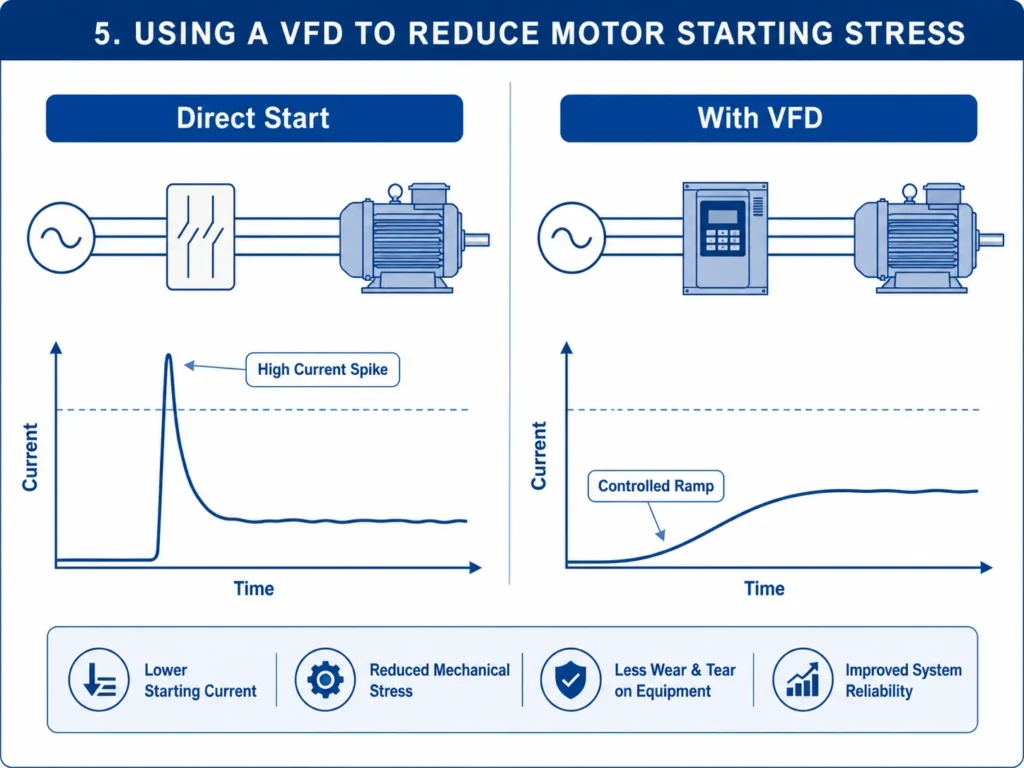
Using a VFD to Reduce Starting Current
A Variable Frequency Drive, or VFD, can be used in many motor applications to reduce starting current.
Instead of applying full voltage and frequency immediately, the VFD gradually increases the motor speed according to a programmed acceleration ramp.
Potential benefits include:
- Reduced starting current
- Lower mechanical stress
- Controlled acceleration
- Adjustable motor speed
- Reduced stress on batteries
- Reduced inverter overload
- Improved pump and fan control
- Better pressure or flow regulation
However, the VFD must be compatible with:
- Motor voltage and current
- Motor power
- Load type
- VFD input voltage
- Solar inverter output
- Required operating frequency
- Environmental conditions
- Protection requirements
A VFD should not be added without confirming compatibility between the motor, VFD, and power source.
Solar Inverter or Solar Pump Inverter?
For water-pumping applications, a dedicated solar pump inverter may be suitable when the main objective is to operate a pump directly from solar panels.
A general solar inverter is normally more appropriate when the system includes:
- Multiple electrical loads
- Battery backup
- Utility-grid connection
- Residential or commercial loads
- Loads that require operation outside solar hours
The correct solution depends on:
- Pump type
- Motor power and current
- Required operating hours
- Need for batteries
- Availability of utility power
- Required pressure or flow control
- Solar conditions at the installation site
System Selection Process
1. Collect the Motor Data
Obtain a clear image of the motor nameplate showing:
- Power
- Voltage
- Current
- Frequency
- Number of phases
- Speed
- Power factor
- Efficiency
- Connection method
2. Identify the Application
Determine:
- The type of machine
- Whether the motor starts under load
- The required starting torque
- The number of starts per hour
- Daily operating hours
- Whether variable-speed operation is required
3. Identify the Available Energy Sources
Determine whether the system will operate from:
- Solar panels only
- Batteries only
- Solar panels and batteries
- Solar panels and utility power
- Solar panels, batteries, and utility power
4. Evaluate the Inverter
Review:
- Continuous power
- Output current
- Surge capacity
- Overload duration
- Inductive-load capability
- Voltage and frequency
- Protection characteristics
5. Design the Battery System
Calculate:
- Battery voltage
- Required capacity
- Continuous discharge current
- Peak discharge current
- Required backup time
- Permitted depth of discharge
- BMS current limits
6. Select Cables and Protection
The design should include:
- Battery cables
- AC output cables
- Circuit breakers
- Fuses
- Surge-protection devices
- Earthing
- Isolation devices
Simplified Application Example
Consider a water pump that will be operated using a solar inverter.
Selecting the inverter based only on the motor’s kilowatt rating is not sufficient. The following information is also required:
- Rated motor current
- Expected starting current
- Whether the pump starts against pressure
- Number of starts per hour
- Required daily operating time
- Availability of a VFD
- Availability of utility power
- Battery specifications
- Other connected loads
After reviewing this information, the suitable solution may include:
- A larger solar inverter with sufficient overload capacity
- A stronger battery bank
- A VFD for controlled startup
- A dedicated solar pump inverter
- Changes to the pump operating method
- Reduced starting frequency
Common Selection Mistakes
Selecting the Inverter Based Only on Motor Power
An inverter with the same rated power as the motor may not provide sufficient starting current.
Ignoring Starting Current
The motor may operate normally after reaching full speed but still fail during startup.
Checking Surge Power Without Checking Its Duration
The inverter’s additional capacity may not last long enough for the motor to accelerate.
Using an Undersized Battery Bank
The batteries may experience excessive voltage drop or trigger inverter shutdown.
Ignoring the BMS Current Limit
A lithium battery may disconnect during motor startup even when it has sufficient stored energy.
Using Inadequate Battery Cables
Undersized cables may cause voltage drop, overheating, and startup failure.
Relying Only on Nominal Solar-Panel Capacity
The actual available solar power varies according to time, weather, temperature, dust, and shading.
Allowing Frequent Starts
Repeated startup current can stress the motor, inverter, batteries, and protection devices.
Ignoring the Mechanical Load
Two motors with the same rating may have completely different startup requirements depending on their applications.
Information Required Before Preparing a Technical Offer
To select the correct solar inverter system, provide:
- A clear motor-nameplate image
- Motor application and connected machine
- Current starting method
- Number of starts per hour
- Required daily operating hours
- Whether the motor starts under load
- Availability of a VFD or soft starter
- Utility-power availability
- Whether daytime-only operation is acceptable
- Battery type, voltage, and capacity
- Required battery operating time
- Other connected loads
- Distance between the batteries and inverter
- Distance between the inverter and motor
- Site temperature and ventilation conditions
Conclusion
Operating motors using solar inverters requires a complete evaluation of the motor, inverter, batteries, solar panels, cables, protection devices, and operating method.
The motor’s rated kilowatt value is not the only selection factor. Reliable operation also depends on:
- Starting current
- Acceleration time
- Mechanical load
- Inverter overload capability
- Battery discharge capability
- BMS current limits
- Cable sizing
- Available solar power
- Starting frequency
A correctly designed system does more than start the motor. It also improves reliability, reduces shutdowns, protects the inverter and batteries, and extends the operating life of the entire installation.
Select the System Based on the Real Application
Before selecting a solar inverter for a motor, pump, compressor, or industrial machine, send the motor nameplate, application details, expected operating hours, and backup requirements to the PowerWadi team.
Our team can evaluate the load, starting requirements, available energy sources, and operating conditions to recommend a suitable solution.